The CODEX SERAPHINIANUS
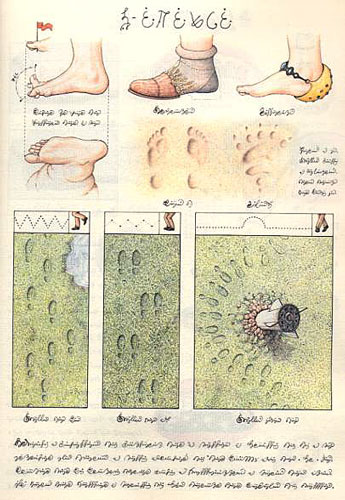
 The Codex Seraphinianus was written and illustrated by Italian graphic designer and architect, Luigi Serafiniduring the late 1970's. The Codex is a lavishly produced book that purports to be an encyclopedia for an imaginary world in a parallel universe, with copious comments in an incomprehensible language. It is written in a florid script, entirely invented and completely illegible, and illustrated with watercolor paintings. The Codex is divided into a number of sections (each with its own table of contents, the page numbers are in base-21 or base-22!) on subjects such as plants, animals, inhabitants, machines, clothing, architecture, numbers, cards, chemical analyses, labyrinth, Babel, foods... There are panoramic scenes of incomprehensible festivals, and diagrams of plumbing!
The Codex is to that imaginary world what Diderot's Encyclopedia is to ours. Obviously, Serafini was not just attempting to create a consistent alternate world. Rather, the Codex is sort of an elaborate parody of the real world.
The invented script of the book imitates the Western-style writing systems (left-to-right writing in rows; an alphabet with uppercase and lowercase; probably a separate set of symbols for writing numerals) but is much more curvilinear reminding some Semitic scripts. The writing seems to have been designed to appear, but not actually be, meaningful, like the Voynich Manuscript.
At is best, the Codex Seraphinianus is really diverting and surrealist; at its worst, it is tedious, kitsch, and childish. This book was surely inspired by the Voynich Manuscript and designed with the spirit of Hieronymus Bosch in mind.
The Codex Seraphinianus was written and illustrated by Italian graphic designer and architect, Luigi Serafiniduring the late 1970's. The Codex is a lavishly produced book that purports to be an encyclopedia for an imaginary world in a parallel universe, with copious comments in an incomprehensible language. It is written in a florid script, entirely invented and completely illegible, and illustrated with watercolor paintings. The Codex is divided into a number of sections (each with its own table of contents, the page numbers are in base-21 or base-22!) on subjects such as plants, animals, inhabitants, machines, clothing, architecture, numbers, cards, chemical analyses, labyrinth, Babel, foods... There are panoramic scenes of incomprehensible festivals, and diagrams of plumbing!The Codex is to that imaginary world what Diderot's Encyclopedia is to ours. Obviously, Serafini was not just attempting to create a consistent alternate world. Rather, the Codex is sort of an elaborate parody of the real world.
The invented script of the book imitates the Western-style writing systems (left-to-right writing in rows; an alphabet with uppercase and lowercase; probably a separate set of symbols for writing numerals) but is much more curvilinear reminding some Semitic scripts. The writing seems to have been designed to appear, but not actually be, meaningful, like the Voynich Manuscript.
At is best, the Codex Seraphinianus is really diverting and surrealist; at its worst, it is tedious, kitsch, and childish. This book was surely inspired by the Voynich Manuscript and designed with the spirit of Hieronymus Bosch in mind.
 An example of Codex Script |  Flexible rainbows |
 Strange people (1) |  Strange people (2) |
 Road warrior |  Larval horse |
 Ladybug melting |  Fish eyes |
 Unvegetables |  X-flowers |
 Zoobotanic (1) |  Zoobotanic (2) |
 Rocket circumambulation |  Boat of the Fools |
 Spaghetti grid |  Shadow dissection |
 Bionic colors |  Utopia of love |
Prodogorium Ac Ostentorum Chronicon


Finished, http://www.propheties.it/nostradamus/prodigiorum/prodigiorum1.html
Demons are said to be evil, bad and frightful. They are said to bring darkness and fear with them to invoke a chill down our spines. Several ancient demons are said to have wreaked havoc and destruction since long. So do demons really exist? Are they fact or fiction? Whether you believe in them or not, you know for sure that there is a fear about them somewhere down in your heart... in your dreams...

There have been several theroies about demons since olden ages. Some people claim to have seen them, some say they are generated out of the deception of mind and some are ready to go to any extent to prove their existence. Some religions used to be that some of the demons were in fact Gods and some said they were demons nonetheless. Let us take a look at the names of some of the most famous and notorious demons from the ancient past.
The Demon Baal
Baal was supposed to be a powerful ancient Judeo-Christian demon. It was understood that he had the powers to make people wise. He also had the powers to make people invisible those who invoke him. It is also learnt that his powers rise take a toll during the month of October. Baal is said to have a hoarse and husky voice. He was also said to possess an army of 66 units under his sole command. Going by the early depictions his appearance was that of a man and animal combination.
Satan (or Shaitan as said in Arabic and Hindi)
Satan was said to be a powerful demon from the ancient world. Usually, Satan, an idol of stone and clay, used to come to life at the will of his evil worshippers. Satan has the distinction of bringing death and suffering to this world. There also theories that Satan was infact a son of God who started a rebellion against God Himself and this might be attributed to the belief of him being so mighty and a powerful demon. Several other theories also exist in other religious scriptures such as that in the Muslim Qur'an. According to Islamic belief and understanding, Satan was a jinn (or jinni) who had powers but wasn't an Angel or God's Son. Due to his human alike freewill he had choosen to rebel against God.
List of Some Other Demon Names:
- Amon
- Abaddon
- Abalam
- Abraxas
- Abyzou
- Ad-Dajjal
- Adramelech
- Aeshma
- Agaliarept
- Agares
- Agiel
- Angra
- Amon
- Abalam
- Abraxas
- Aeshma
- Agaliarept
- Agares
- Agiel
- Aim
- Akem
- Ala
- Alastor
- Alloces
- Allu
- Amaymon
- Amdusias
- Ammut
- Anzu
- Amon
- Andhaka
- Andras
- Andrealphus
- Andromalius
- Antichrist
- Apep
- Apollyon
- Asag
- Astaroth
- Asura
- Azazel
- Balam
- Balberith
- Bali
- Banshee
- Baphomet
- Barbas
- Bathin
- Beherit
- Belial
- Beleth
- Bies
- Boruta
- Bukavac
- Bune
- Caim
- Charun
- Chemosh
- Chupacabr
- Corson
- Crone
- Culsu
- Dagon
- Dantalion
- Danjal
- Dasa
- Davy Jones
- Eligos
- Euryale
- Eurynome
- Foras
- Forneus
- Furies
- Furcas
- Furfur
- Gader'el
- Gaki
- Glasya-Labolas
- Gorgon
- Haagenti
- Halphas
- Haures
- Humbaba
- Ifrit
- Incubus
- Ipos
- Iblis
- Jinn
- Kabhanda
- Kitsune
- Kobal
- Kokb'ael
- Kulak
- La Llorona
- Lamia
- Legion
- Lechies
- Lempo
- Mammon
- Mara
- Maricha
- Marchosias
- Medusa
- Mictlantecuhtli
- Mojo
- Moloch
- Murmur
- Naamah
- Naberius
- Naberus
- Naphula
- Nekomata
- Neqa'el
- Ninurta
- Nix
- Nyai Loro Kidul
- Obizoth
- Onoskelis
- Oray
- Orcus Roman Mythology
- Oriax
- Orobas
- Ose
- Oni
- Paimon
- Pazuzu
- Penemue
- Phenex
- Pithius
- Pocong
- Pontianak
- Popobawa
- Procell
- Pruflas
- Psoglav
- Purson
- Putana
- Raging Demon
- Rahab
- Rahovart
- Raiju
- Rakshasa
- Rangda
- Raum
- Ravana
- Razakel
- Ronove
- Rosier
- Rumjal
- Rusalka
- Sabnock
- Saiko
- Sallos
- Salpsan
- Samael
- Satanachia
- Scox
- Seere
- Semyazza
- Set
- Shaitan
- Shax
- Shedim
- Shezmu
- Sidragasum
- Sitri
- Stheno
- Stolas
- Stuhac
- Succubus
- Surgat
- Tannin
- Tartaruchi
- Temeluchus
- Teeraal
- Tengu
- Titivillus
- Tuyul
- Ukobach
- Utukku
- Valefar
- Vapula
- Vassago
- Vepar
- Verrine
- Vine
- Volac
- Vual
- Vucub Caquix
- Wendigo
- Xaphan
- Yeqon
- Yeter'el
- Yokai
- Yuki-Onna
- Zaebos
- Zagan
- Zepar
- Zmeu
- Zin
- Ziz
